The conversation regarding who we are always makes me feel uneasy. Don't get me wrong, conscious source-backed discourse is always necessary and quite frankly, evolutionary. But arguing over something that was designed to disrupt the flow of information is falling victim to the system, once again. There are two things that I know to be true: No one can call me anything I don't answer to. Several narratives can exist at the same time.
So I did the research. DNA results returned, African, Aztec, Egyptian, More Africa, a little colonizer, and more African. I took two different tests. Both of which updated their results within a year. That's not strange at all. So archival research was the path forward. I wanted to know more about the people, the land, the history. I didn't go looking for the aboriginals, they found me.
There is a particular kind of silence that follows Black families through the archive. It does not sound like absence. It sounds like clerks. It sounds like census takers. It sounds like county courts, plantation inventories, marriage licenses, labor contracts, land grants, death certificates, and men with government seals deciding what a human being was allowed to be called.
Each word arrived with authority. Each word pretended to describe us all. Each word was also a filing system. For generations, Black people in America have been told that our history begins at the ship, hardens at the auction block, and becomes legible only after 1870, when formerly enslaved people were finally listed by name in the federal census. We are told that before that point there is a wall—a brick wall, a dead end. A bureaucratic cliff where family memory drops into the ledger and disappears.
But I did not find a wall. Yes, originally I did run into it a little bit, but I moved it out of my way.
I found names. I found Ellen. I found Sam. I found Sally. I found Motley Norman and William Ives Norman.
I found Norment Lane in Whiteville, Tennessee. I found a Freedmen's Bureau labor contract dated January 1, 1866. I found the plantation family that held my ancestors in bondage. I followed that family backward from Tennessee to Alabama, from Alabama to Virginia, from Virginia to a 1714 land patent on the branches of Cohoke Swamp in King William County, and from there toward the older colonial world where land, labor, race, and power were being written into law.
This is not abstract history to me. This is my family. This is my bloodline. This is research I conducted because the labels were not enough. The deeper I went, the more obvious it became that the fight over Black origins in America has been deliberately misdirected. We argue with each other about who we are because powerful institutions spent centuries changing the paperwork that told us who we were allowed to be. The argument itself is part of the inheritance.
Part IThe Lane
If you search Whiteville, Tennessee, and find the rural line now known as Norment Lane, the map will not explain what happened there. It will show fields. It will show roads. It may show the ordinary geometry of agricultural land: tree lines, cleared acreage, long property divisions—the quiet infrastructure of a Southern county that has learned how to look innocent from above.
But my family's record does not let that land remain ordinary.
My third great-grandmother, Ellen Norment, was born around 1842. She appears in the family line at the precise historical rupture where Black genealogy often becomes difficult: after Nathaniel Ellis Norment, slave owner, had already established a plantation presence in Hardeman County, Tennessee, and after his estate had entered the legal machinery that divided land, wealth, and enslaved people among heirs.
Ellen was not born into a vague historical condition. She was born into a system with names, owners, acreage, probate files, surnames, and courts. She was born into a world where the law did not recognize her as a full person, but the law still recorded the value of her labor, the transfer of her body, and the wealth produced by people like her.
That is the first cruelty of the archive: the same system that tried to erase enslaved people also documented the transactions that exploited them. The second cruelty is that descendants must learn to read those records against the grain. You cannot search for your ancestors as citizens before citizenship. You must look for them where the enslavers looked: wills, inventories, tax lists, estate divisions, bills of sale, labor contracts, plantation account books, and court disputes.
That is the level of research this required. Not a casual online search. Not a family-tree hobby. This required reconstructing a world from fragments. It required reading surnames as evidence. Reading geography as evidence. Reading who lived beside whom in 1870 and 1880 as evidence. Reading the difference between Norman and Norment not as a spelling error, but as a survival mark.
Part IIThe Contract
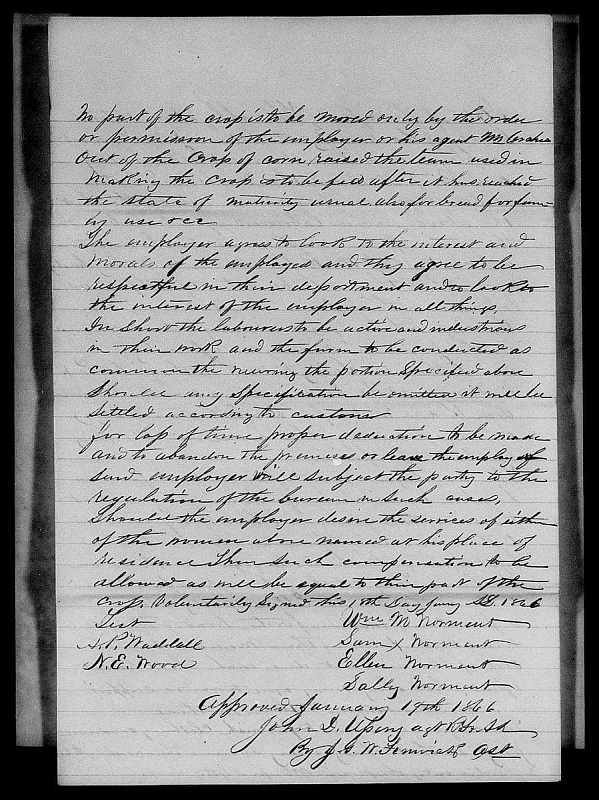
The document that changed everything was a Freedmen's Bureau labor contract from the immediate aftermath of the Civil War. On January 1, 1866, Sam Norment, Ellen Norment, and Sally Norment entered into a labor agreement with William M. Norment. The document places them in the Reconstruction economy at the exact moment when slavery had legally ended but land ownership, capital, tools, housing, and political power remained overwhelmingly in the hands of the former slaveholding class.
This is the transition many American textbooks flatten into a sentence: the enslaved became free. But freedom, on paper, is not the same thing as land. It is not wages. It is not safety. It is not literacy. It is not a mule, a deed, or legal protection from the very families that had owned the fields, houses, barns, cotton, and roads.
For families like mine, emancipation did not mean walking into a clean future. It meant negotiating survival on familiar dirt under new paperwork.
The labor contract matters because it names people. It establishes proximity. It shows family structure. It shows that Ellen, Sam, and Sally remained connected after emancipation, and it places them in direct relation to the Norment estate system. That kind of document is not merely genealogical evidence. It is a hinge in American history. On one side: human beings counted as property. On the other: human beings entering contracts, still constrained by poverty and coercion, but now visible as legal actors.
The structural transformation of our family from "property" to free citizens is captured entirely in a single, remarkable document dated January 1, 1866—a handwritten Freedmen's Bureau Labor Contract preserved in the National Archives (NARA Record Group 105). For decades, standard digital indexes misread the elegant, cursive script, transcribing the employer's name as "W.N. Norment." But a direct inspection of the original ledger reveals the true hand behind the pen: William M. Norment—the Reverend William Menefee Norment, son of the original planter.
"This obligation entered into between Wm M Norment, employer, and Sam Norment, Ellen Norment, Sally Norment, the mother and sisters of Sam Norment above named… Witnesseth, that the above named labourers agree to labor on the farm of said employer under the directions and controll of Mr Rufus Archer…"
It was on this very land, just five years later in 1871, that Ellen gave birth to our second great-grandfather, William Ives Norman. William grew up on Norment Lane during the height of Reconstruction. His children's generation—James, Gertrude, August, Adell, and William—would navigate a world where the family surname fluidly shifted between Norment and Norman on marriage certificates, land deeds, and school rosters as they carved out their independent lives away from the plantation's shadow.
The Bloodline — Ellen Norment to the Author
Part IIIThe Complexity of the Search
People often underestimate what it takes to trace an enslaved line. They imagine genealogy as names connected to dates. But African American genealogy requires forensic discipline. It is history, law, geography, paleography, migration studies, archival science, and emotional endurance at once.
To follow this line, I had to move through multiple layers of evidence:
- Family memory
- Census reconstruction
- Surname variation
- Plantation geography
- Freedmen's Bureau records (NARA RG 105)
- Hardeman County history
- Slave schedules (1850/1860)
- Probate logic and estate distributions
- Colonial land records (Virginia Patent Books 10 & 12)
- Migration patterns from Virginia into the Old Southwest
- The paper trail of statutory and administrative racial reclassification
| Year / Era | Location / Event | Historical Status |
|---|---|---|
| 1714 | Virginia Tidewater | Samuel Norment secures 410 acres at Cohoke Swamp, King William County—boundary lines sitting within Pamunkey and Mattaponi river territory (Patent Book 10, p. 229). |
| 1780s–1810s | Tobacco Exhaustion | Soil depletion pushes the planter class to move operations westward; enslaved families are mobilized as human capital. |
| 1815–1825 | The "Alabama Fever" | Forced overland migration into the Deep South; human lineages recorded as inventory items in probate ledgers under partus sequitur ventrem. |
| 1826 | West Tennessee Arrival | Nathaniel Ellis Norment establishes a cotton plantation and textile factory in Hardeman County; ceded lands cleared by coerced labor. |
| Jan 1, 1866 | The Hinge | Freedmen's Bureau contract executed at Whiteville. Ellen, Sam, and Sally Norment sign as legal actors, remaining on familiar dirt under new terms. |
| 1871 | Free Ground | William Ives Norman is born on the same land, into Reconstruction—the family surname shifting between Norment and Norman across the records. |
Part IVThe Older Land
The Norment trail did not stop in Tennessee. The white Norment family's movement followed a broader pattern of American expansion: from Virginia tobacco lands into Alabama, then into West Tennessee after the Chickasaw cessions opened new territory to white settlement and cotton cultivation.
That migration was not merely a family relocation. For enslaved people, it was forced migration. When planters moved, enslaved families moved under compulsion. They cleared new fields. They built new houses. They opened roads. They made unbroken land profitable. The wealth of the "frontier" was not created by ambition alone. It was created by coerced labor.
Following the Norments backward led to a 1714 patent for Samuel Norment: 410 acres in King William County, Virginia, on the branches of Cohoke Swamp. That detail matters. Cohoke Swamp was not empty land. King William County sits in the Tidewater world of the Pamunkey and Mattaponi peoples, whose communities long predated European deeds. The rivers, swamps, and fertile lowlands that colonial records describe as grants and patents were already part of Indigenous homelands.
The Pamunkey and Mattaponi are two of the core tribes of the historic Powhatan Confederacy. For thousands of years before European arrival, they inhabited, stewarded, and governed the rich riverfronts along the Pamunkey and Mattaponi Rivers. When early colonial land grants were issued, it was these ancestral sovereign territories that were systematically carved up into tobacco plantations. Despite centuries of intense colonial encroachment, forced assimilation policies, and attempts to legally erase their identity through racial classification laws (such as Virginia's 1924 Racial Integrity Act), both the Pamunkey and Mattaponi maintained their communities and their continuous reservation lands in King William County, preserving a direct line to the original keepers of that soil.
When the colonial system expanded, it forced Indigenous lines and early African arrivals together on the same land. Throughout the 1700s and 1800s, colonial and state legislatures passed a sequence of laws that systematically altered how people of color were recorded. This structural erasure was legally grounded in Virginia's Act XII of December 1662, which codified partus sequitur ventrem—declaring that a child's legal status followed that of the mother. This law seamlessly locked generations of both Indigenous and African women into hereditary labor assets. If an Indigenous woman had a child with a man of African descent, or if an Indigenous family was forced into labor on a tobacco plantation like the one at Cohoke Swamp, the census takers and tax assessors stopped writing "Indian." Instead, they unleashed a rotating door of administrative labels:
- First, they were classified as "Mulatto" (a fluid legal catch-all utilized by colonial courts to disrupt indigenous sovereignty and land claims).
- Later, they became "Negro."
- By the time the plantation system moved to Tennessee, they were simply recorded as "Black property."
- After the Civil War, they became "Colored."
- Today, we are told the blanket term is "African American."
This constant, multi-generational shifting of words was not accidental. It was a deliberate strategy of paper erasure. By classifying everyone with dark skin or textured hair under a singular, imported identity, the American legal system effectively cut off millions of people from their rightful, ancient inheritance to the very land they were standing on. It successfully tricked us into arguing over whether we belong to this country, while hiding the fact that our blood was already mixed with the soil before the first ship from Scotland ever dropped anchor.
The Norments obtained their captured workforce through two primary avenues:
- Direct Transatlantic Cargo: During the late 1600s and early 1700s, British merchant ships, heavily backed by the Royal African Company, sailed directly into the York and Pamunkey Rivers, docking at ports near King William County (such as West Point). Planters purchased captured men, women, and children directly off these ships to clear the dense timber lines of the Tidewater.
- The Interception of the Indigenous: Concurrently, colonial Virginian planters weaponized the Indian Slave Trade. Dark-skinned, highly melanated Indigenous people captured during early colonial conflicts (such as the aftermath of the Anglo-Powhatan Wars and Bacon's Rebellion) were systematically forced into labor alongside arriving African captives, a process accelerated by the Virginia Slave Codes of 1705 (Act V), which legally grouped all non-Christian servants imported "by sea or land" into standard property tax laws.
By the time Nathaniel E. Norment moved from Virginia to Alabama, and finally to Norment Lane in Whiteville, Tennessee in 1826, the international slave trade had been legally banned (1808). To build his cotton empire, he utilized the Domestic Slave Trade:
- Generational Inheritance: A large portion of the workforce was passed down through generations as "property" from Samuel Norment's 1714 estate down through family wills in Caroline and Mecklenburg County, Virginia. Families were systematically bred, torn apart, and moved across state lines as inheritance.
- The "Alabama Fever" Markets: When Nathaniel moved his operations to Alabama during the 1810s land boom, he purchased additional human beings from active domestic trading hubs in Virginia and North Carolina. Specialized human traffickers marched chains of enslaved people (coffles) hundreds of miles down the Federal Road into the Deep South to satisfy the demands of expanding planters.
So the paper trail does something profound. It reveals overlapping dispossessions. First, Indigenous land becomes colonial property through patent and settlement. Then African and Indigenous labor histories are forced into plantation economies. Then enslaved families are moved as property across state lines. Then emancipation arrives without land redistribution. Then the state continues deciding what descendants are allowed to be called.
The result is not a simple origin story. It is a layered American wound. Let's learn a little bit more about the family that participated in such atrocities.
The Norment Family Profile & Estate History
The story of the Norment family and their plantation roots traces a classic line of early American migration: originating from Scottish stock that had fled to colonial Virginia, moving briefly into the Deep South, and ultimately establishing a prominent, prosperous estate in Hardeman County, Tennessee (near Whiteville) during the early 19th century.
- The Virginia Roots (18th Century): The Norments were an old Virginia family of Scottish origin, not English. By the mid-to-late 1700s, branches of the family were established in counties like Prince William, Fauquier, and Mecklenburg.
- The Multi-State Trek — The Alabama Leg (1815–1825): This is where the trail gets grueling. Nathaniel did not move straight from Virginia to Tennessee. He followed the classic "Old Southwest" migration path down into Alabama during the 1810s land boom. Before settling permanently in Tennessee, he lived and operated in Alabama for roughly a decade, where he met and married his third wife, Sarah Menefee (Menifee), a woman of English-Dutch extraction originally from Knox County, Tennessee.
- The Norment Plantation & Industrial Footprint: Nathaniel E. Norment quickly became one of the most successful and prosperous planters in Hardeman County. He built the first and only cloth manufacturing factory (a cotton mill) in Hardeman County near Whiteville.
- Prominent Second-Generation Sons: Nathaniel and Sarah had seven children together. Two of their sons became foundational civic, religious, and economic leaders in 19th-century West Tennessee: John S. Norment (b. January 31, 1828) and Rev. William Menefee Norment (September 21, 1829 – 1924).
- Summary of the Family Legacy: The Norments represent the quintessential trajectory of the antebellum Southern elite, moving from Virginia Planter Class origins through westward expansion and industrialization to post-war survival as influential merchants and civic leaders.
- Deep Historic Alignment: Looking further back, the earliest recorded patriarchs of this specific branch—including Joseph (Josue) Norment (born c. 1639) and later Samuel Norment (born c. 1680)—arrived in the Virginia colony when it was still wild frontier land, having fled or been exiled from Scotland in the turmoil of the Covenanting Wars and Cromwellian conflicts. They did not arrive as Europeans in the abstract, and they did not remain refugees: they were Scots who, handed other people's land, built their fortune on stolen ground and stolen people.
The Norments did not buy their land from a regular real estate market; they received it directly from the British Crown under the Headright System in the tidewater regions of New Kent, King William, and King and Queen Counties (the areas that would later be split to form Caroline County). For every person a planter paid to transport across the Atlantic, the Crown awarded them 50 acres of virgin land. Early Virginia Land Office patents show the Norments anchoring themselves along the Mattaponi and Pamunkey rivers—prime, raw riverfront property perfect for launching a tobacco empire.
The 1714 patent explicitly states that Samuel didn't homestead this land from scratch—it was "purchased by his father," which pushes the Norment footprint in Virginia back into the late 1600s. His father bought this tract from Thomas Pitblado and John Hume before it was formally re-patented by Samuel in 1714 to secure the legal title under King George I. The land was located along the branches of Cohoke Swamp in King William County, feeding into the Pamunkey River. In the early 1700s, riverfront swamp tracts like this were highly prized because they offered incredibly fertile, moist soil perfect for cultivating high-grade tobacco.
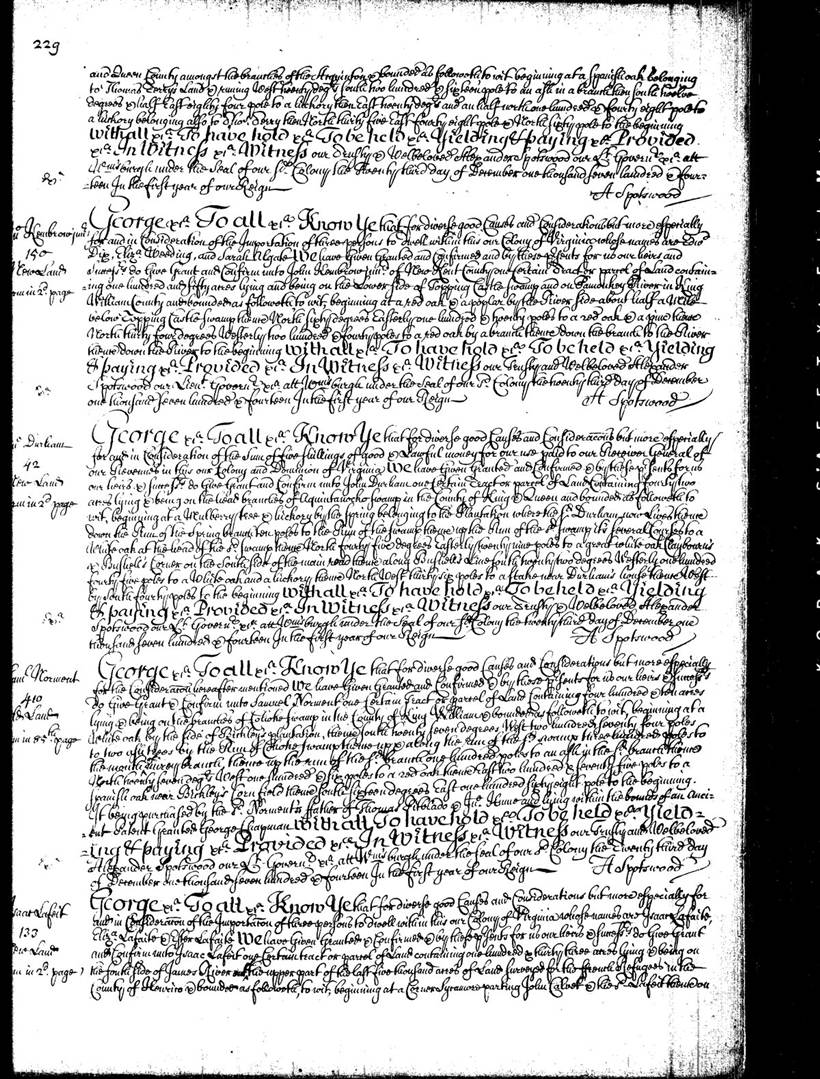
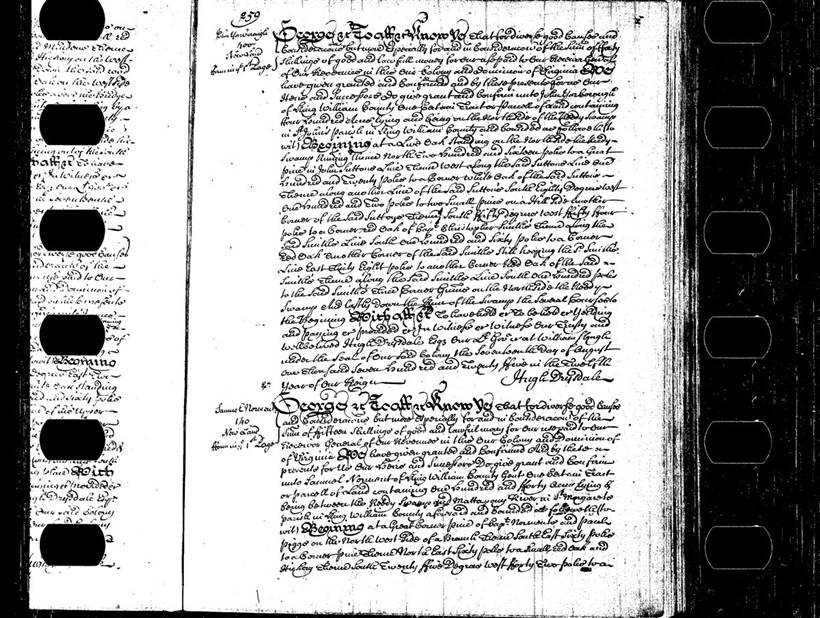
When Samuel patented those 410 acres in 1714 (Patent Book 10, p. 229), he established a family dynasty that relied entirely on generational wealth. Because enslaved people were legally passed down through wills from fathers to sons as chattel property, the ancestors of Ellen, Sam, and Sally were integrated into this exact chain of custody. When Nathaniel Ellis Norment decided to leave Virginia, the descendants of the people who originally cleared the Cohoke Swamp lands in the 1700s were the ones loaded into the wagons to clear the new frontier of Whiteville, Tennessee.
On January 1, 1866, when Wm M. Norment signed his name to the Freedmen's Bureau contract, he was trying to preserve the agricultural empire his great-great-grandfather Samuel had set in motion 152 years prior. But right below his name, when the clerk wrote Sam Norment, Ellen Norment, and Sally Norment, it signaled a monumental shift. They were no longer line-items in a probate inventory like those recorded after Nathaniel's death in 1839. They were recognized as free individuals entering a legal contract.
Part VThe Reclassification Machine
The deeper question is not only where my family lived. The deeper question is: who had the power to classify them? This is where the story moves from family genealogy into national identity.
In Virginia, one of the clearest examples of bureaucratic racial violence came through Walter Ashby Plecker, the first registrar of Virginia's Bureau of Vital Statistics. Plecker served from 1912 to 1946 and became a central enforcer of racial classification under Virginia's 1924 Racial Integrity Act. His campaign targeted Indigenous identity with chilling precision. To eliminate any intermediate legal ground between "White" and "Colored," Plecker distributed circular letters to local courthouse registrars, threatening criminal prosecution if they accepted "Indian" designations for specific local surnames.
Virginia Indians who did not fit the state's preferred racial categories were pressured, recategorized, or erased on paper. Records were altered. Families who identified as Indian were pushed into "colored" classifications. Public documents became weapons. This is not conspiracy; it is documented policy.
And it matters because classification is not neutral. Classification controls inheritance, marriage, land claims, tribal continuity, school access, political recognition, and historical memory. To rename a people on paper is to interfere with their descendants' ability to know themselves. That is why the modern argument over whether Black Americans are "African American," "Black," "Indigenous," "Aboriginal," "Freedmen," or something else often becomes so emotionally charged. We are not arguing over vocabulary alone. We are arguing inside the wreckage of a records system designed to separate us from specificity.
| Era | Category applied | Systemic function |
|---|---|---|
| Early Colonial (pre-1670) | Non-Christian servants / "heathens" | Distinguished European indentured labor from imported and Indigenous captives before lifelong racial castes were codified. |
| Colonial Statutes (1682–1705) | Negro / Mulatto / Indian | Consolidated lifelong hereditary servitude via the Virginia Slave Codes of 1705; civil liberties stripped from non-white populations. |
| Antebellum / Federal (1790–1860) | Free Persons of Color / Mulatto | Imposed taxes and movement restrictions on non-reservation, free families of color; an unstable legal middle ground. |
| Reconstruction (1865–1877) | Freedmen / Colored | Re-integrated emancipated people into the agricultural economy as sharecroppers—without land or capital redistribution. |
| Jim Crow / Administrative (1924–1946) | "Colored" only (the binary) | Enforcement of the Racial Integrity Act of 1924 under Walter Plecker; the "Indian" category abolished outside bounded reservations. |
1. The Weaponization of the Legal Pen
Traditional history relies on the assumption that archival records are objective truths. My research exposes the reality that the archives are often crime scenes where the evidence was systematically altered. By using terms like "Mulatto," "Negro," and "Colored" as shifting legal catch-alls, the state created a system where identity was tied to status, not origin. If a highly melanated person was sovereign, they were an "Indian" with land rights. The moment they were forced into the plantation labor structure, their classification was altered to strip away those rights.
2. The Colonial Statutes: The "Indian" and "Negro" Legal Equivalency
The earliest colonial laws provide direct, textual evidence that the original inhabitants of the land matched the physical description of the people being imported from Africa. If the original inhabitants were completely distinct in appearance, the laws would not have needed to bundle them into identical racial classifications.
The Virginia Act of 1682 (Act XI): the colonial assembly passed a law to explicitly define who could be legally enslaved for life. The text states:
"All servants imported and brought into this country… who were not Christians in their native country… shall be accounted and be slaves… and all Indians, which shall hereafter be sold by our neighbouring Indians, or any other traffiqueing with us as for slaves are hereby adjudged, deemed and taken to be slaves."
The 1705 Virginia Slave Codes consolidated the definitions:
"All servants imported and brought into this country, by sea or land, who were not Christians in their native country… shall be accounted and be slaves, and as such be here bought and sold notwithstanding a conversion to Christianity."
The law specifically applied the word "Negro" as a legal catch-all to cover both imported Africans and local, dark-skinned American Indigenous populations.
3. The Maritime Law Trajectory: Banishment and the "Out of Sight" Loophole
Under colonial law in 17th- and 18th-century Virginia and New England, keeping highly melanated, sovereign Indigenous people enslaved on their own ancestral lands was incredibly dangerous for the colonizers. They knew the terrain, their families were nearby, and they could easily orchestrate rebellions or escape back to their tribal territories. To solve this, colonial governments weaponized maritime law and international shipping codes:
- The Transshipment Strategy: Colonizers passed explicit laws stating that Indigenous captives taken in "just wars" or structural land grabs were to be sentenced to transportation and banishment.
- The Loophole: By physically placing an Indigenous person onto a ship and sailing them out into international waters, their legal status under local colonial treaties was completely severed. Under the jurisdiction of Admiralty and Maritime codes, they were legally converted into "maritime cargo."
- The Exchange: Ships would take American Indigenous captives to the Caribbean (Barbados, Jamaica) or Europe, sell them there, and then load the same ships with captives from Africa or the West Indies to bring back to Virginia.
4. The Visual Reclassification: Making the Land Look "Empty"
This constant shuffling of human cargo on maritime vessels directly created the visual illusion that all Black laborers were imported from across the sea. If a tax assessor or colonial clerk saw a dark-skinned, highly melanated person working a tobacco field at Cohoke Swamp, and that person was known to be from the local Pamunkey or Mattaponi territory, that person was a living testament to a stolen sovereign birthright.
But if that person—or their family members—had been processed through a shipping port, maritime bills of lading and port registries simply recorded the cargo under blanket customs terms like "Negro," "Piece of India," or "Servants bound by water." During the colonial Indian Slave Trade (particularly between 1670 and 1720), tens of thousands of coastal Indigenous people were captured and placed onto vessels out of ports like Boston, Charleston, and the York River in Virginia, where the manifests frequently listed them simply as "New England Negroes" or "Carolina Negroes"—the word describing appearance, not geographic origin. By routing people through ships, the commercial revenue system effectively created an administrative record that made it appear as though everyone so labeled had been imported from across the ocean. This allowed the colonial courts to falsely declare the territory as terra nullius (empty land), hiding the fact that many of the people working the crops were the original owners of the dirt.
In short: they used maritime law to physically displace the original people and disrupt their power, and they used the visual uniformity of melanin to classify everyone coming off a ship under a singular, imported slave narrative. It was the ultimate shell game to hide an occupied nation in plain sight.
5. Tax Assessments and the "Free Persons of Color" Loophole
In the late 1700s and early 1800s, tax ledgers listed a growing population of "Free Persons of Color" (FPOC) or "Mulattos" living on independent tracts of land adjacent to tribal swamps and waterways (like the Cohoke Swamp). When you trace these specific families backward using land deeds, you find they were not freed slaves; they were aboriginal families who had never left their ancestral soil. Because they refused to move to federally bounded reservations, the county tax assessors simply applied the legal label of "Mulatto" or "Colored property holder" to strip them of tribal status while ensuring they could be heavily taxed.
The evidence isn't missing; it was simply translated by the oppressor into a language of property and captivity.
6. The Insatiable Math of Generational Wealth
At the root of this behavior is a simple, brutal economic equation: Land + Labor = Absolute Power. In the 1700s, tobacco was the equivalent of oil today; by the 1800s, cotton was the undisputed global currency. To maximize profit in these multi-billion-dollar industries, colonizers required two things: free land and free labor. If the white Norments or any other planter family acknowledged that the people working the soil were actually the sovereign, Indigenous owners of that very land, they would legally owe them rent, resources, and sovereignty. By using the pen to reclassify them as "imported property," they wiped the financial ledger clean. Greed behaves this way because it requires total ownership to sustain its generational dynasties.
7. Alleviating Cognitive Dissonance
Psychologically, most humans cannot look in the mirror and comfortably see themselves as monsters. To commit horrific acts—like tearing families apart, trafficking children, and stealing ancestral soil—the oppressor must invent a psychological and legal framework to protect their own ego.
- The Bureaucratic Smoke Screen: This is why they weaponized the law. If a county clerk shifts a category on a piece of paper, or if a politician passes the Racial Integrity Act, the violence is sanitized. It transforms an act of theft into an act of "administrative order."
- The Dehumanization Loop: By labeling an Indigenous person as "Negro cargo," the colonizer convinces himself that he is simply managing an asset, not occupying a nation or destroying a family.
8. The Fragility of Power and the Fear of Retribution
The behavior of men like Walter Plecker in the 20th century was driven by intense, bureaucratic panic. Power structures built on a lie are incredibly fragile. Plecker and the Virginia elite understood that if millions of highly melanated people realized they weren't just visitors brought on ships, but were actually the rightful, sovereign heirs to the very land the state was built on, the entire legal foundation of segregation, property deeds, and white supremacy would collapse overnight. The paper genocide was a defensive, preemptive strike. They altered the data because they feared the truth would strip them of their stolen authority.
The bottom line: they behaved this way because the pen is the ultimate weapon of an occupying force. It allowed them to commit a crime, inherit the wealth, and then write a textbook that blamed the victim for having no history. My work in translating these records, at least for my family, is what breaks that psychological loop, forcing the truth back into the light.
Historical Context: The Virginia Racial Integrity Act of 1924
"We have a list of local surnames belonging to families who have for years claimed Indian status to evade segregation laws and retain underlying land considerations. You are hereby directed to register these individuals strictly as 'Colored' or 'Negro.' Any clerk who knowingly accepts an 'Indian' designation for these family lines shall be subject to prosecution under the terms of the Act."
The Forensic Evidence of "Paper Genocide": The strongest proof that melanated aboriginals existed is the massive bureaucratic effort the government undertook to erase them from the record. If they were not there, the state would not have spent centuries passing laws to alter their birth certificates and land titles. Plecker explicitly recognized that dark-skinned people claiming sovereign Indian identity held legal and territorial rights that threatened white land ownership.
The Surname Lists: Plecker compiled exhaustive lists of specific family surnames in Virginia counties (such as King William, Amherst, and Rockbridge) and sent them to local courthouses, schools, and hospitals. He ordered that anyone carrying these ancestral names must be registered exclusively as "Colored" or "Negro," making it a penitentiary offense to use the word "Indian."
Scratched-Out Records: In the archives of the Library of Virginia, forensic inspection of early 20th-century census records and birth registers reveals physical evidence of this erasure. Entries that originally held the abbreviation "Ind" (Indian) were systematically crossed out or erased by hand and replaced with the number 2 or the letter C, representing "Colored."
This systematic administrative pressure fundamentally altered how generations of families appeared in subsequent federal census records. When the census takers arrived, they categorized households based on the state's mandated designations rather than the family's self-determination or geographic continuity. To accommodate elite white citizens claiming romantic lineage from Pocahontas, Plecker added the "Pocahontas Exception," allowing individuals with less than 1/16th Indian blood to remain classified as "White"—exposing that the statute was never a biological measure, but an economic and political shield designed to preserve white land tenure and consolidate the segregation binary.
Quantitative Impact of Bureaucratic Reclassification: The administrative elimination of intermediate and Indigenous racial categories had a drastic, measurable impact on population records. Following the enforcement of the Racial Integrity Act of 1924, state-level data showed an artificial, immediate demographic shift. Across multiple non-reservation Tidewater counties, recorded native populations dropped dramatically between the 1920 and 1930 censuses; the people had not died or migrated—they had simply been bureaucratically reclassified as "Negro" or "Colored" by the stroke of a pen.
Reclaiming the Forensic Lineage: For authors, researchers, and descendants navigating this complex terrain, the methodology requires transitioning away from passive genealogical databases and moving toward active paleographic and geographic reconstruction. The receipts are not silent; they are waiting in the un-indexed pages of the state archives for those with the discipline to read them correctly.
Part VIThe Trap of a Single Label
I am not writing this to flatten Black America into one origin. That would repeat the same mistake. Black people in America do not descend from one story. Some descend from Africans trafficked through the transatlantic slave trade. Some descend from Indigenous peoples reclassified through colonial and state systems. Some descend from both. Some descend from multigenerational communities whose identities were changed so many times by clerks, courts, churches, and census takers that the surviving paper trail looks contradictory by design.
The point is not to replace one imposed label with another. The point is to stop letting imposed labels end the investigation.
"African American" may describe part of a history. It may describe culture, political experience, diaspora, and shared struggle. But it cannot be allowed to function as a locked room. It cannot be used to tell every descendant of slavery that their only ancestral meaning begins across the Atlantic and never touches the land beneath their feet.
My family's research shows why. In my line, the record moves through an enslaved family attached to the Norment plantation in Tennessee, back through a white planter migration from Virginia, back to a colonial land patent in King William County, back into the river world of the Pamunkey and Mattaponi, and forward again through Reconstruction, surname shifts, and survival. That does not give me permission to make careless claims about every Black family. It gives me the responsibility to say this: the archive is more complicated than the labels.
Part VIIWhat I Wanted, and What I Learned
At one point in this research, I thought about lawsuits. That reaction was human. When you find names, land, contracts, and evidence that your ancestors' labor built wealth they were forbidden to own, the courtroom can feel like the obvious destination. You want somebody to answer. You want the ledger dragged into public view. You want the descendants of the people counted as property to be treated as heirs to the truth.
Then I thought I wanted the land. To own the dirt where they were once owned seemed like the cleanest form of poetic justice.
But the research sharpened the desire into something larger. I do not merely want land. I want Black people in America to stop being forced into arguments created by the people who reclassified us. I want us to stop treating the records as if they were honest just because they were official. I want us to understand that a birth certificate can lie. A census can flatten. A deed can conceal theft. A plantation biography can praise industry while omitting the people whose bodies made the industry possible.
I want us to know that when our ancestors appear under changing names, that does not make them confused. It means the system kept changing the terms of recognition. I want us to stop fighting each other over labels long enough to ask who benefited from making the labels so unstable in the first place.
Part VIIIThe Receipts Are Sacred
The most powerful thing about this research is not that it gives a final answer to every question. It does not. There are still documents to pull. Probate inventories to inspect. Deed books to examine. Census neighbors to map. Court records to compare. Tribal histories to treat with care and respect. Claims that require proof must remain claims until the documents support them.
But what has already emerged is enough to change the frame.
My family was not a rumor. Ellen was not a blank. Sam and Sally were not shadows. Motley Norman was not an isolated name. William Ives Norman was not merely a Reconstruction child with a surname that shifted on paper. They were part of a long, traceable, complex history that moved through bondage, labor, land, reclassification, and survival.
That matters.
In a country that repeatedly renamed us, finding the names is an act of recovery. In a country that repeatedly moved the boundary lines of race, finding the records is an act of resistance. In a country that told us the wall was impenetrable, every document becomes a door.
The question is no longer whether we have a history. The question is whether America is prepared for what happens when we read it correctly.
Part IXWhat I Know Now
I know that my family's story cannot be contained by a single category.
I know that the plantation was not the beginning.
I know that "African American" is too often used as a period where there should be a question mark, a comma, a footnote, a court record, a land patent, a tribal boundary, a family Bible, a Freedmen's Bureau contract, and a grandmother's memory.
I know that the people who controlled the records controlled the story for a long time. But not forever.
Because I found Ellen. Because I found Sam. Because I found Sally.
Because I followed the paper past the plantation, past emancipation, past Tennessee, past Virginia, past the official labels, and into the older question America has spent centuries trying to avoid:
What if the people this country tried hardest to classify were never confused about who they were? What if the confusion was the system? What if the receipts were always there, waiting for a descendant stubborn enough to read them?
This is my family. This is my history. This is the result of research that required discipline, grief, skepticism, pattern recognition, and refusal.
I am not asking America to give me an identity. I am taking back the right to investigate the one it tried to bury.
Sources & Method
This essay distinguishes between the documented record and the author's interpretation. Primary documents are cited below; the broader historical argument built on them is the author's own.
- DocumentFreedmen's Bureau labor contract, Jan 1, 1866 — Records of the Field Offices for the State of Tennessee, BRFAL, RG 105, National Archives (NARA); Hardeman County contracts. Employer Wm. M. Norment; laborers Sam, Ellen & Sally Norment; manager Rufus Archer; approved by agent John D. Ussery, Jan 19, 1866.
- DocumentSamuel Norment land patent, 23 December 1714 — 410 acres on the branches of Cohoke Swamp, King William County, VA. Land Office Patents No. 10, 1710–1719, p. 229 (Reel 10), Colonial Land Office records, Library of Virginia, Richmond.
- DocumentSamuel Norment land patent, 17 August 1725 — 140 acres between Reedy Swamp and the Mattapony River, St. Margaret's Parish, King William County, VA, adjoining Capt. Norment and Paul Pigg. Land Office Patents No. 12, 1724–1726, p. 259 (Reel 11), Library of Virginia.
- DocumentVirginia statutes — Act of December 1662 codifying partus sequitur ventrem; Act XI of 1682; the Virginia Slave Codes of 1705 — in W. W. Hening, The Statutes at Large… of Virginia.
- DocumentThe Racial Integrity Act of 1924 & the record-alteration campaign of registrar Walter Ashby Plecker, Virginia Bureau of Vital Statistics (1912–1946) — documented policy. Secondary: J. David Smith, The Eugenic Assault on America; Helen Rountree, Pocahontas's People.
- DocumentU.S. Federal Census & Slave Schedules (1830–1880), Hardeman County, TN, Dist. 11 (Whiteville); Goodspeed's History of Hardeman County, Tennessee (1887).
- InterpretationThe framing of "overlapping dispossessions," the maritime reclassification thesis, and the reading of shifting racial labels as a deliberate mechanism are the author's analysis — a historical-translation argument offered for inquiry, consistent with the essay's own standard that claims requiring proof remain claims until the documents support them.